Guanciale
The party starts here.
Cured pork jowl, sautéed in its own fat. Roman tradition calls for guanciale: at BIGA we do not replace it with bacon or pancetta.

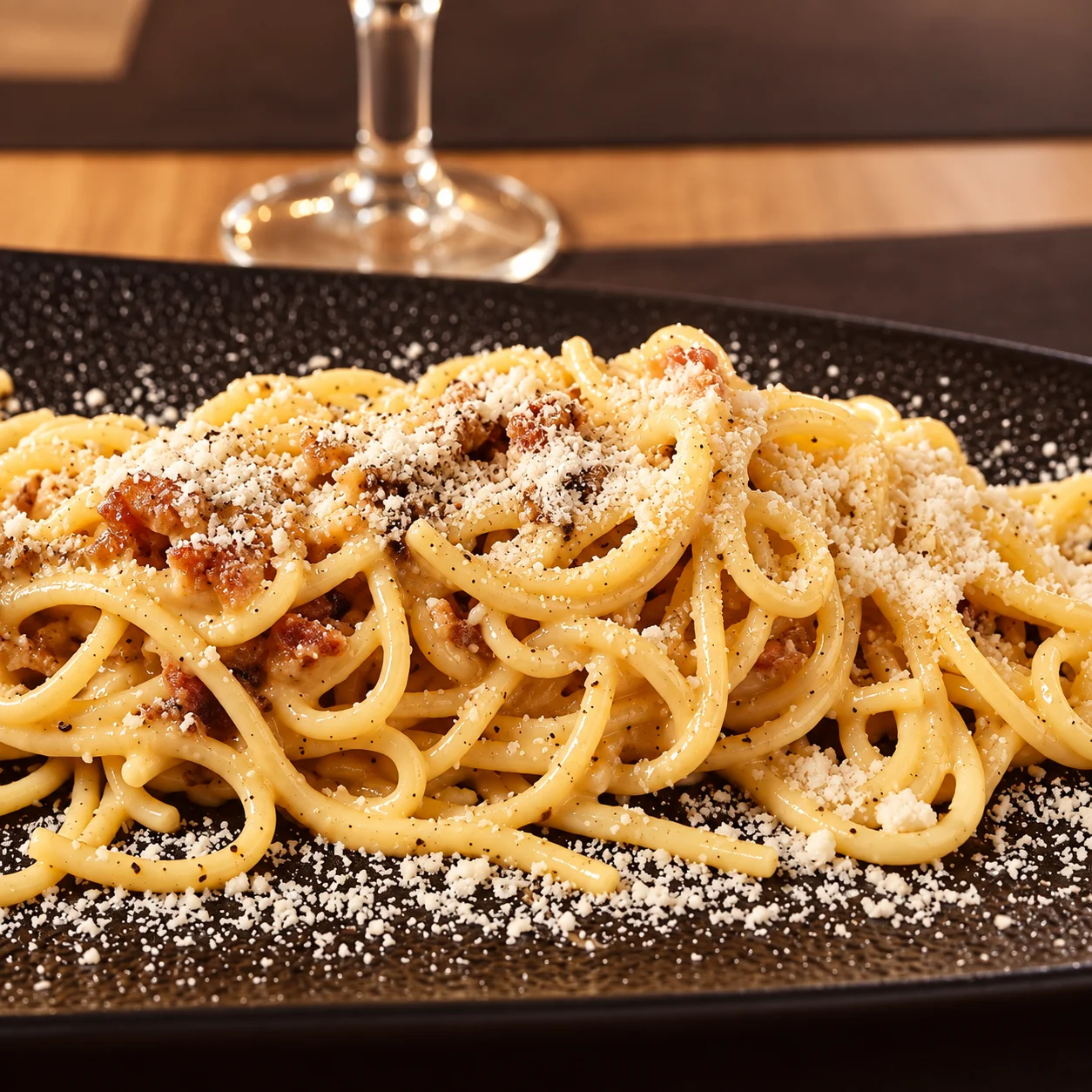
Rome takes this seriously. So do we.
No cream. No shortcuts. Everything it should have.
Looking for carbonara in Castellón? At BIGA we follow the traditional Roman recipe: Pecorino Romano PDO, guanciale sautéed in its own fat, ground pepper and egg yolk. You will find us in Oropesa del Mar. The carbonara comes from Rome.
Love at first forkful
Four stars on a bed of pasta. Each has a role. Nobody is here as a filler.
The party starts here.
Cured pork jowl, sautéed in its own fat. Roman tradition calls for guanciale: at BIGA we do not replace it with bacon or pancetta.
Cheese with a full name.
Pecorino Romano with Protected Designation of Origin. Bold, salty and unmistakably Roman.
Creaminess without cream.
We use Italian egg yolk, with a deeper yellow colour and a more intense flavour. Together with Pecorino, it brings creaminess to an exceptional dish.
The final plot twist.
Its aromatic kick completes the dish. Small in size, big in character.
Not on the guest list
Neither are mushrooms, onions or added milk. Our carbonara needs no extras to be creamy. We let every ingredient do its job.
Contains egg and milk from Pecorino Romano PDO cheese. Check the menu for pasta allergens and possible traces. Check allergens ↗
Carbonara is an icon of Roman cuisine, but its exact origin remains debated. Well-known theories connect it to charcoal makers or to the meeting of Italian cooking and Allied troops’ ingredients during the Second World War. Neither settles the question.
Its name is debated too: one theory links it to carbonari, charcoal makers; another to black pepper resembling coal dust. These are hypotheses, not certainties. La Cucina Italiana published a recipe in August 1954, recording a dish that evolved into the Roman tradition we follow today.
And guanciale? Its name comes from guancia, Italian for cheek: the cut of pork it is made from. It is a different cut from the belly used for pancetta.
The recipe published in 1954 ↗Our guests have a say
Read the original review«La pasta boloñesa y carbonara de lo mejor que he probado.»
Emilio S · Tripadvisor · 25/05/2025
At BIGA, Av. de Madrid 25, Local 5, Oropesa del Mar, in the province of Castellón. We follow the traditional Roman recipe. See our menu and book online.
High-quality spaghetti alla chitarra with Pecorino Romano PDO, guanciale sautéed in its own fat, ground pepper and egg yolk. We add no cream, mushrooms, onions or milk.
Egg yolk and Pecorino give the sauce body; starchy pasta cooking water helps bind the guanciale fat and adjust the texture. Controlled warmth and mixing off the heat create a silky sauce without cream.
No. We add no milk or cream, but Pecorino Romano PDO cheese contains milk. The dish also contains egg; check the allergens before ordering.
From Rome to your first bite
Try our Roman carbonara in Oropesa del Mar. Explore the menu and book your table online.
Av. de Madrid 25, Local 5 · Oropesa del Mar, Castellón